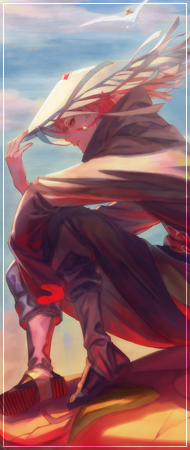
Many years ago, hidden away within the rank and file of Kirigakure, there existed an abrasive old man by the name of Ju Sang-Sik. Known to his comrades in the Kirigakure Hunter-Nin as the Heavenly Handed Ghostly Healer, he was a master of many fields, including Taijutsu & Bukijutsu, but he excelled in the art of locating and utilizing Pressure Points to his advantage, even during combat, or whilst fighting on an active battlefield. With these skills he was not only able to assassinate his designated targets with minimal effort, he also gained a reputation for sparing his comrades from painful deaths, either by putting them out of their misery, or reducing the severity long enough for proper treatment to be administered. This came as no surprise to the Mizukage, as he had been trained in the methods of the Hunter-Nin since infancy, so it was only natural for him to excel in these fields. But the Mizukage could never dare to imagine that Ju Sang-Sik would betray him... Sadly for the Mizukage though, the Doctor had grown tired of his life as Kirigakure, and more specifically being the Mizukage's personal hit man. He had seen, and brought, enough death into the world as it was. He didn't wish to be personally responsible for bringing in any more. With this in mind, he packed his stuff, and sent a direct warning to the Hunter-Nin Corps, and the Mizukage himself. If they dared to send even a single Shinobi after him, they would find out in the worst possible ways that his title was not as kind-hearted as it seemed...
With his life in Kirigakure behind him, Ju Sang-Sik decided on a whim that he wanted to help people, using his unique skills to better others lives, save them if he could. With this in mind he moved to a small, isolated town somewhere in the Land of Fire, and opened his own Chiropractic Clinic and Hospital. He garnered a reputation of treating any patient, no matter how far gone, and when commissioned, he would even travel to other Lands to provide his services. However, the seemingly innocent practice the Doctor had set up also had its own dark secrets. Despite wishing to help the innocent and needy, he still retained his abrasive and abusive personality, a lingering effect from his time in a Village soaked in blood to its very core. Ju Sang-Sik was also more than aware that the Mizukage wouldn't just leave him be, as he was one of his most accomplished and decorated assassins. If left to his own devices he could very well destroy the foundation upon which Kirigakure was built, if he so desired. And although that wasn't exactly his intention, he had set events in motion that could ensure just that. Beneath the Heavenly Handed Ghost Healer's Medical practice was a secret training dojo. On his trips to the neighbouring lands, the good Doctor would look for potential future prospects, and ask him if they wished to be like him. If they said yes, they were brought back to the practice, and trained in the same methods as he. If they refused, or were in no position to say yes, he would use his skills to simply abduct them. And so began many years of training and perfection in the Doctor's methods. Many promising students eventually splintered from the Doctor's grasp and control, and would either do great good, or great harm to the world. One example of the former was was a Doctor by the name of Na Bong-Chim, who used the art of Acupuncture to help anyone he could, much like Ju Sang-Sik did in his recent years. One other example, a case of the latter, became a famous hitman known only as "Hit", as it took precisely one hit from his Acupressure to kill his targets, emulating the Heavenly Hands in his younger days. This is precisely what Ju Sang-Sik wanted. Disciples of his own, who possessed his skills, but were not bound by the borders of the world, the ideals or influence of Villages, the weight of bonds, emotions or friends. They could do whatever they wished, reap chaos, or try and fix it, Ju Sang-Sik did not care. He merely wanted to show that he could be responsible for true change. Or perhaps he simply wished to give the Mizukage the middle finger, but no one but the Doctor himself knew for sure.
Of course the Mizukage had the Ninja of Kirigakure watch him for his motives, movements, and eventually discovered the Doctors plans to release a personal army of trained disciples upon the Ninja World. They made many attempts to stop him, all of which intending to take the Doctors life, however, every single one only ended with a fresh cadaver for the Doctor to dissect and study. In the name of science of course... And as the years passed, and more and more assassins sent after him, and with many prospective youths trained and loosed upon the world, and just as many lives of regular people improved or saved, Ju Sang-Sik was beginning to feel like he had made a change in the world. It was either that, or his senility getting the better of him... But despite his age, he wished to continue his vision of helping people but with his hands not what they used to be, he had no other choice but to choose a successor. Someone who would take up the mantle of "Heavenly Hands". Eventually he found one as driven as he, so he taught him the ins and outs of his methods. Over the course of many months the Doctor gave this whipper snapper a long and educational training session that eventually came to be known as the training required to utilize a Style of combat that transcended the boundaries of close quarters combat, in more ways than one... This was the birth of "Tenrenraku", the Heavenly Contact fighting style.
This Fighting Style is based on the concept of locating, targeting and attacking specific locations on the target’s body, generally referred to as “Pressure Points”, which are points in the body where, if enough of a certain pressure were applied, the user achieves specific effects on that part of the body. What separates this from existing Fighting Styles of a similar nature, such as the Hyūga Clan’s “(Jūken) Gentle Fist”, is that by attacking these points the user is attempting to harm or affect the targets physical body, unlike the aforementioned Gentle Fist, which attacks and disrupts the targets Chakra Flow. Users of this Fighting Style are taught, not only how to locate and attack nerve clusters, joints, blood vessels, etc, but also identify unique weak points on any part of any individual’s body. This emphasis on attacking the physical body, instead of the Flow of the targets Chakra, essentially makes this Fighting Style and Gentle Fist night and day when compared to one another, as although they both utilize similar stances and physical forms of attacks, they achieve polar opposite effects.
Heavenly Contact is broken into several parts, the first of which is the identification and targeting of an opponent’s Pressure Points. To the practitioners of this Fighting Style, this training, and the subsequent ability gained from it, is commonly referred to as “(Attengan 圧点眼) Pressure Point Eye”, however this is not a Dōjutsu. It's merely a part of their training in which they are trained to identify points on the body that are susceptible to this Fighting Style’s techniques, and is more of an inside joke than an actual Dōjutsu. All users of this Fighting Style are trained to locate Pressure Points on the body, including the aforementioned examples such as blood vessels, joints, nerve clusters, and more specific locations that are susceptible to direct strikes and pressure, like the wind pipe, eyes, jaw, etc. However, there are other parts of the body the user can target, parts which one cannot read about in a book, or be taught to identify otherwise. This is because every Shinobi’s body is different. Every single one of us have our own strong and weak points, both throughout our bodies, and in a more general sense. We all have our failings, places we do not excel as much as others, and places we try hard to excel in, but cannot no matter how hard we try. As a result of each Shinobi’s uniqueness, one doesn’t have to rely on being trained in one single method to pinpoint the same locations on the body, and thus training and knowledge that would seem beneficial to this, like the advanced familiarity with the inner workings of the body one gains with Medical Ninjutsu training, are, at best, supplemental and, at worst, superfluous when it comes to this Fighting Style. This identification of an opponent’s Pressure Points is a passive action performed by the user, but must be done before any techniques from this Fighting Style may be employed, regardless of their nature. Due to this, it is best to perform this action at the start of a fight, when the user will, most likely, be facing their opponent, and will have a clear view of the majority of their body, meaning it is far easier to locate the majority of their Pressure Points. Additionally, Shinobi who possess a means of assisting their targeting of their target’s weak points, such as a Dōjutsu, also have far more ease when doing so. For example, the Byakugan would allow it’s user to more easily spot points in the body that are weaker or generally more susceptible to a Jutsu from this Fighting Style, for example, places on the body where bones have been broken in the past, and could be more easily exploited than other points, while the Sharingan’s enhanced perception could potentially tell, from reading muscle movements and other telling motions, where damage has been sustained in the past, and leaves a lingering effect on that part of body, whether that effect is physical, psychological, or both. These are just basic examples, but any valid method of assisting in the detection of weak points is applicable in the assistance of this Fighting Style. Additionally, this insight into the location of Pressure Points also allows the user to locate their own Pressure Points, and subsequently perform the techniques of this Fighting Style on themselves, should it’s application be beneficial or at least applicable in some manner. Upon learning how to locate their target’s Pressure Points, the user can move on to the next part of their training: The physical methods the user employs to attack Pressure Points.
The physical aspect of this Fighting Style is broken down into two parts, both of them possessing radically different styles and processes, but still intent on achieving the same goal of attacking and applying pressure to Pressure Points. The offensive styles for this Fighting Style are as follows;
(Atsuryokujutsu) Pressure Arts: Pressure Arts are made up of many different styles of Taijutsu actions, stances motions and attacks, and focus on the hand-to-hand aspect of Heavenly Contact. Atsuryoku is made up of a mash up of various styles and stances from a great number of martial arts, with a heavy emphasis on fast, strong “poking” attacks, mainly performed with the index and/or middle finger, which target the opponent’s Pressure Points with direct, focussed strikes. However these are not the only kinds of attack employed by practitioners of this Fighting Style, as Atsuryoku also employs grab attacks, grapples, holds, pinches, and many other similar forms of physical actions, all of which have a emphasis on restricting or restraining their opponent’s actions in some way, even allowing the user influence over the positioning of the targets body, allowing them to strike at harder to target Pressure Points far more easily than without such attacks and actions. To increase the physical strength and durability of their finger(s), the user channels Chakra into the desired digits, increasing not only their physical capabilities, but their potential damage output as well.
(Senshijutsu) Puncture Arts: Puncture Arts are the second, ranged equivalent Pressure Point Combat style within the Fighting Style, and utilizes Bukijutsu through Ninja Tools, specifically Senbon, to penetrate the skin and apply both direct damage and pressure to the opponent’s Pressure Points. This ranged usage of the Fighting Style means that the user can perform this Fighting Style’s techniques at a distance, lessening the probability of receiving a counter-attack from one of their strikes, and usually giving the user a clearer view of their opponent, making it easier to target Pressure Points. Of course, this broadcasts the users intent, as it is far easier to notice a Senbon being thrown from several feet away than it is to notice a stealthy jab with a finger in the heat of a direct confrontation. However, Senshi can also be utilized within Close Quarters, driving a needle into the target's Pressure Point while using other, preferably flashier movements to conceal their true intent, leaving the Senbon embedded in the target. Just like with the Pressure Arts, the user channels Chakra into their Senbon, not only to increase the tools physical capabilities, but to help increase their flight speed, focusing the Chakra on the Senbon's point to reduce resistance while they fly through the air.
Now that the identification of, and the methods the user employs to attack Pressure Points have been explained, the final part of this Fighting Style is the effects the user can inflict upon the opponent by attacking their Pressure Points. These effects are determined by several factors, such as the location of the Pressure Points, the kind of attack the user employs in order to attack the Pressure Point, the angle and force of the attack, etc. The effects of Heavenly Contact techniques are split down into the types of Pressure points the user can target, and areas follows;
Pain Points: The simplest to learn, and easiest to perform of all Heavenly Contact applications, by striking, placing pressure upon, penetrating, or generally attacking most Pressure Points on the targeted body, the user creates pressure in the surrounding area, causing differing levels of pain, depending on the technique used, which range from mild discomfort to unbearable levels of pain. User's of Heavenly Contact can also utilize these kinds of Pressure Points in order to help others, such as an ally that has suffered severe wounds in combat. They can utilize this form of Heavenly Contact to generate pain in a different part of the body, drawing their attention away from the real injury. This can also be used to help one relieve themselves of their own injuries for a short time, granting the user anywhere from a brief respite from their wounds, to complete neutralization of any pain they may feel, so long as they continue to strike at, or keep a Senbon lodged in one of their "Pain" Pressure Points. Though anyone who uses this application on themselves must be careful, as their wounds are not "treated", not even in the slightest. Ignorance of wounds and pain are bound to only make them worsen as time goes on, and as such, this application should be used sparingly, especially during active combat. Pain Points are amongst the most abundant of Pressure Points, and are mostly found in or around tendons, ligaments, and muscles, making them both easy to locate, and target, as they are found in almost all regions of the body.
Restriction Points: Usually paired with the effects of Pain Points, Restriction Points are stuck to generate pressure in order to restrict or completely immobilize the area surrounding the struck Restriction Point. This is very effective should the user manage to immobilize an opponent's arm(s) or leg(s), as it makes their job far easier because their opponent will have less options with which to counter with. Similar to Pain Points, Restriction Points also have beneficial applications, such as preventing someone who is seriously injured from flailing about, potentially worsening their injury. Regardless of the way it's used, Restriction Points are a vital part of the Heavenly Contact Fighting Style, as the ability to immobilize anyone with a couple of finger strokes, or tactically placed Senbon is crucial, especially in combat. Restriction Points are found mostly in the same regions as Pain Points, and as such, when one is utilized, the other is usually applied.
Blood Points: A more advanced form of Heavenly Contact, Blood Points allow the user to regulate the pressure of blood flow in and around the area where the pressure is applied. Due to the nature of Blood Points, it is advised to never try and use Puncture Arts on a Blood Point, as it is very likely to do more harm than good. Blood Points are best targeted with Pressure Art actions, especially pinches, grapples and other such "gentler" usages. Blood Points can be used to slow blood flow in the area around an injury, thus making it easier to treat, cause dizziness in an opponent due to reduced blood flow in critical areas, thus throwing them off balance, or even lowering the user's own blood pressure for usages as simple as calming themselves. An example of a Blood Point includes the baroreceptors in the carotid artery, which are pressure-sensitive, and supply the brain with information to control systemic blood pressure. Placing pressure on this point will send signals that indicate that blood pressure is too high, leading to a lowering of blood pressure.
Joint Points: These are, as one might expect, Pressure Points that are only found in or around joints. Their primary application is to allow the user to weaken these parts of the body, allowing the user to easily dislocate and break joints. These parts include a targets elbows, wrists, fingers, knees, hips, ankles, jaw, etc. Even dislocating or breaking something as small as a finger joint can be incredibly useful to a practitioner of Heavenly Contact, as it can mess up the performance of seals, throw off an opponents offence, and generally gives the user a major advantage in combat.
Reflex Points: Reflex Points grant the user some control over the involuntary actions of their target. These include causing the targets hand to release its grip, the knees to buckle, or even forcing the target to gag. One specific attack that employs a Reflex Point is the "Golgi Organ Strike". By applying even a relatively gentle strike to the Golgi tendon at the back of the elbow triggers a reflex that immediately relaxes the tendon, allowing the elbow to bend more easily in the wrong direction. If this is directly followed by a solid strike to the elbow joint, the elbow can be broken with significantly less effort than it could through brute force. Reflex Points are usually paired with Joint Points to completely immobilize the opponent with minimal effort, and pain inflicted on the opponent.
Concussive Points: The final, and most deadly form of all Pressure Points are Concussive Points. They are so named for their power to cause disorientation in a target, and can render a target unconscious when struck hard enough. These are almost exclusively found on the skull, and along the spinal column, making them incredibly difficult targets, even for a Master of this Fighting Style.
Each of these effects will be thouroughly explained in all of the Fighting Style Jutsu they appear in, and as mentioned before, some of these effects can be performed on the Practitioners themselves, should their applications be beneficial or supplementary in nature, however, all of these give the user an unprecedented level of depth in their approach to hand-to-hand combat. Additionally, the techniques of this Fighting Style, when applicable, can be used to assist in the counter other forms of physical attacks, such as physical forms of Ninjutsu, that are performed against the user. For example, if a large boulder made from Earth Release is fired at the user, the user can apply their training from this Fighting Style to analyze the surface of that boulder, locate a structurally weak point on the surface of the boulder, and use Taijutsu to apply pressure to that point, and break it apart before it can do actual harm to the user. Of course, the Rank of the enemy Jutsu, and the guidelines and interactions between Elements, Raw Chakra and Taijutsu are also taken into account with such interactions. Finally, the duration of effects of this Fighting Style can vary wildly, depending on how they are applied. If they are applied via “(Atsuryoku) Pressure” the effects are temporary but cannot be undone, and usually last a set period of time, usually a couple of turns at most. This is due to more force and pressure being exerted on the targeted Pressure Point, leading to lingering effects from this. If the effects are applied via “(Senshi) Puncture”, the effects can either persist for as long as the senbon remains lodged within the opponent’s body, constantly applying pressure to the targeted Pressure Point, or, depending on the technique, will some times only trigger its effect after the Senbon has/ have been removed. Once again, these will be described, in detail, in every Fighting Style Jutsu. The wildly varying styles, usages and effects of Heavenly Contact make it a very versatile and useful Fighting Style for any practitioner taught in it.
Must have completed, and specialize in, Basic Taijutsu.
Must have completed Basic Ninjutsu, for Bukijutsu proficiency & accuracy.