Does... anyone actually pay attention to the material in the series?
"I think it has to do with the solar system!"
"No, it has to do with Norse mythology."
"Nu-uh - it is clearly from the Abrahamic religions. I mean. Two sons - obviously Cane and Abel."
"Susano'o is clearly a celtic reference. It has a sword."
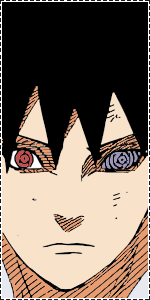
The Rinnegan is symbolic of the Six Paths of Buddhism.
You must be registered for see images
You must be registered for see links
"Also occasionally read rikudou-e. Literally Six Paths. Paintings of the "six paths" (rokudou 六道) of existence are also called the "six realms" (rokushu 六趣) of reincarnation . According to Buddhist thought, all living beings are caught in an endless cycle of birth, death, and rebirth into one of the "six realms" being reborn up or down the scale according to the extent or lack of one's purity and good deeds in the previous existence. One can escape only by achieving enlightenment."
Note the term Rikodou.
Or do you think Kishimoto just pulls names/titles for people out of his behind?
Speaking of names:
You must be registered for see links
" As she handed it to him, the feather robe was placed on her shoulders, and all of her sadness and compassion for the people of the Earth were forgotten."
"There have been suggestions that The Tale of the Bamboo Cutter is adapted from the Chinese legend Chang'e[citation needed] and is related to the tale of Swan Lake[citation needed]. This probably is due to Kaguya-hime wearing the hagoromo (羽衣 "feather robe") when she ascends to her homeland. But the hagoromo figures more famously in a group of tales known as the hagoromo densetsu (in one example recorded in the Ōmi-no-kuni Fudoki tells of a man who instructs his dog to steal the hagoromo of eight heavenly maidens while they were bathing, forcing one of them to become his bride). And the latter is remarkably similar to the tale of the Chinese traditional Magpie Festival legend of the Fairy Couple. Also similar to the story of how Völundr Smith and his brothers wedded the swan-maidens."
Which leads us to:
You must be registered for see links
"Tennin (天人), which may include tenshi (天使), ten no tsukai (天の使い, lit. heavenly messenger) and the specifically female tennyo (天女) are spiritual beings found in Japanese Buddhism that are similar to western angels, nymphs or fairies.[citation needed] They were imported from Chinese Buddhism,[1] which was influenced itself by the concepts of heavenly beings found in Indian Buddhism and Chinese Taoism.
.
.
.
Tennin can fly, a fact generally indicated in art by their colored or feathered kimonos, called hagoromo ("dress of feathers").[1] In some legends, tennin are unable to fly without these kimonos (and thus cannot return to heaven).[4] More rarely, they are shown with feathered wings."
You must be registered for see links
"The heavenly beings presented here are not objects of worship. Rather, their function is to protect Buddhist law by serving the Deva (see TENBU). Most originated in India’s earlier Vedic traditions. The Sanskrit term for these celestial beings is Apsaras (also Apsara) -- it refers to the divine beauties and dancers who populated Lord Indra’s court in Hindu mythology."
You must be registered for see links
"Indra or Sakra or Śakro devānām indraḥ. A major Hindu god who serves as king of the gods on Mt. Sumeru (Jp. = Shumisen 須弥山), and as a protector of the Historical Buddha (Shaka 釈迦如来). Known as Taishakuten 帝釈天 in Japan, one of the Twelve Deva, and often shown together with Bonten (Skt. = Brahma)."
Now we need to address the Sharingan:
You must be registered for see links
You must be registered for see images
This is a partial reference to Buddhism, but comes in triplicate for a reason:
You must be registered for see links
"The Shinto world-view is often argued to be (like the Catholic) tripartite - it forms a trinity or three tiered structure and this is evidenced in a number of ways. Firstly, Gods are classified according to a bipartite structure; there are gods of the heavens, gods of the earth. With the addition of the mundane world this becomes a three-part classification. Secondly Shinto mythology is often structured as taking place between three worlds. Such worlds include - "
You will actually find the description of the worlds relatively interesting - as there is mention of most of the Sharingan's 'god moves' (named after gods - who'da thunk it) as well as some interesting associations between the 'worlds' and the gods/goddesses that rule over them.
Anyway - the three tomoe appearing on three rings likely represents the three worlds of Shinto and each tomoe stands for either the relationship of the gods or various gods that are said to rule over those worlds (it is not entirely clear).
You guys realize the internet is for more than pornography, right?