This is precisely why I lectured you on reading comprehension.
Simultaneous events can be arranged in any particular order and be chronologically consistent. The ordering is chosen by the author for a deliberate reason.
This is what I mean by realizing that the events aren't real. You keep prattling on about how "things should be" without realizing that it is what Kishimoto intends it to be.
The problem with your reasoning is that the next chapter opens with the completion of IT. Further, simultaneous events in Naruto are rarely illustrated completely unbroken. For an example of this, see:
You must be registered for see links
,
You must be registered for see links
, and many other examples of simultaneous events and stories that play out with multiple interruptions, occasionally within the same page.
If Kishimoto were intending to show Naruto's reaction to IT on the whole, this:
You must be registered for see links
, would have been a good place to insert it, and more consistent with how Kishimoto typically displays Simultaneity.
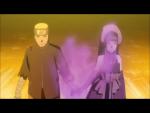
Instead, we get a protracted affair where everyone is hypnotized, then Madara uses a jutsu to summon the tree to ensnare everyone. Of all the characters possible, Kishimoto cuts to Hinata's perspective (giving many the impression that she's one of the few resisting - though it's hard to tell since she's the only one we actually 'hear from' during her falling under IT).
After which, we see Naruto's reaction.
Mangapanda's Page 15 could have gone into Page 11's spot (shifting everything else to the next higher page) and been just as, if not more effective, at conveying simultaneity as well as drama. It is the order I would have chosen were I not trying to make a point.
Except that I predicted Kaguya would wield the Byakugan - and not for simple explanations of: "because Kakashi said there was a rumor."
For starters, you have to understand a bit about the religious/spiritual history of Japan - which had a long history of ancestor and nature worship prior to the more standardized views coined under Shintoism. Contact with the Chinese mainland brought very heavy Taoist influences into everything, and many of the ideas of Taoism blended almost perfectly with the ideas of Buddhism (that were already making their way east through Asia).
The God Tree - or the Kodama known as Wakunochi-no-kami, is a concept that predates even Shintoism and was later incorporated into it. In the Izu island chain, Aogashima was home to a group of people who worshiped the Japanese cedar tree, no doubt the influence for the Uzumaki Clan.
You must be registered for see links
The Uzumaki represent the Pre-Shinto beliefs that were often shamanistic and brazen, involving ceremonial masks, blood catalysts, scrolls written with allegedly magical words or power, etc.
Kaguya, no doubt, is a reference to The Bamboo Cutter that is about an old woodsman who finds an infant girl inside of a glowing bamboo stalk (often cited as one of the oldest works of science-fiction). Turns out, Kaguya was a space alien from the moon (or the stars - depending upon which version you're reading), and her people (there were more of them) eventually came to take her back home - where they placed a Hagoromo (feathered cloak - often worn by Buddhist "angels") over her shoulders and she instantly forgot her concerns for the people of the planet after becoming immortal.
Of course, what led me to begin all of that research is the Hyuuga ties to Taoism and the way in which Naruto structures conflicts and solutions specifically around many Taoist conundrums. Neji's tale is all about the conundrum of destiny within Taoism. The very concept of "Don't try to save the world by yourself, Naruto" is one of the very cruxes of Taoist wisdom and teaching. The very concept of: "Nothing is done, yet nothing is undone" was developed as advice to Chinese emperors after Taoist philosophers noticed that the less emperors did to try to solve the problems of their people, the better off the emperors' districts were (they were Libertarians before it was cool).
Anyway - the symbols on Naruto and Sasuke's hands are Taoist symbols for the moon. Naruto's, in particular, is the symbol for "Return." The Eight Trigrams seal is the progression of Yin/Yang through the eight elements - the structure of the seal implies heavy Taoist influence (in fact, the whole yin/yang concept is Taoism, as is the Five Elements system occasionally evoked - which applies more to Taoist medicine) - yet it is clearly stated to be an Uzumaki technique (and the 'extreme' nature of it would certainly support that assertion).
The Hyuuga were always intended to be important and part of the story. Nothing Kishimoto has done in regards to this has been random. Kaguya was meant to have the Byakugan - representing the spread of Taoism into the nature-worshipping regions of Japan. Taoism gave system and structure to a set of legends, tales, and traditions. It took "the legend of mystical rocks that pull metal" and combined it with "theories of physical forces" to produce a refined theory of magnetism and magnetic induction (as a relative comparison).
Buddhism was seen as a sort of 'secondary' Taoism, or "Taoism of life experience." This is why the Rinnegan - representing the Six Paths - or Six Phases - of life, is so tied into concepts of human suffering. The Buddhist Cycle of Human Suffering describes the transitions that people make through various parts of their life, and also describes the natural rise and fall of empires/societies. Naruto's confrontation with Nagato was specifically in regards to how to bring about the end of suffering. Nagato insisted that he could interrupt the cycle through his own actions - to engineer the cycle by introducing destruction and loss.
Madara/Obito insisted it could end if the "heaven" phase could be suspended indefinitely by depriving everyone of the freedom to exit it.
Hagoromo insisted it could be ended if everyone were given access to a power that was not their own (though it's not clear that he truly wished to bring an end to human suffering - any sage with a lick of sense would know precisely what people would do with unnatural power).
Kishimoto is not random. He has a tendency to get in a rush to insert ideas he's had in his head since the series began, and the result is less than a natural-feeling transition... but a lot of this is stuff that he's had in mind for quite some time. The first 100 chapters or so flows very well and introduces new concepts without it feeling like the author is jerking the plot around. 500 chapters later, he's run out of buffer to build up intricate detail. He's still got so many ideas to introduce and so little plot time to do it - which is why we're seeing a complete break-down of "physics" within Naruto. I'm sure if Kishimoto had put the series on hiatus for a year or so following the destruction of the Leaf to think things through, we would have a much more natural feeling plot with fewer "I'm going to pull stupid amounts of energy out of my butt after 36 hours of non-stop fighting." In other words - he would have had a manga with far more consequences to the characters and better pacing - just as it was in the original series (where people took a week to heal from battles that brought them near death).
*shrug* I know you are, but what am I?
Am I supposed to be impressed, or something?
If you had a letter of recommendation from a college instructor who actually did something notable in his/her life, I might be intrigued. Otherwise, I'm dealing with someone who doesn't know the difference between two, to, and too.
I've been in charge of enough college graduates to consider having a degree a negative indicator of intellectual capacity.
And where has that analysis gotten you?
You insist that his plot decisions are random - yet I can clearly show you how they are planned and fit within well defined themes. While my 'model' is somewhat incomplete, it has already been useful in predicting events within Naruto.
Your degree means nothing in the real world. Your ability and illustrations thereof are what are important. You and 60,000,000 other people whose names will never be known to history have the degree you claim to share with them.
The problem is that you fail to consider your cultural blindness.
Well, that and what you consider "subtle" is what most people I bother to interact with consider 'blatantly obvious.' So there's a clear difference in caliber, here.
Anyway - Kishimoto uses many subjects that are common within Japanese culture and history. What you would call some "subtle religious hint" is what would be akin to The Justice League naming a new villain "Judas" or a fortress "The Alamo."
Basically, if you grew up in Japan and have the capacity to feed yourself, you will get it.
So, under your "model" of this series' production... Kishimoto is just sitting there, saying: "Okay, so Sasuke and Naruto are making sweet love under Susano'o's shielding... oh, yeah... Naruto should be concerned about those side characters... let's see... oh, I'll actually draw what's going on outside Susano'o, since I'm not writing Yaoi....
So... hypnosis... we'll just make the edos immune to it, why the hell not... and tree roots ensnare, just like the Sage was talking about - Rinnegan, he's important.... um.... Mei hasn't had panel time in a while..... oh, and this will be hot - a hypnotized Hinata getting wrapped in bondage - the fan boys will love that. ... Okay, now for Naruto's reaction to all of this."
....
What if I told you...
Susano'o was planned to be the counter to Tsukuyomi?
Susano'o is the god of tempestuous seas, brother to the goddess Amaterasu and god Tsukuyomi. (On a side note - Susano'o slayed the eight-headed serpent: Yamata-no-Orochi...). Anyway - Susano'o is also known as the God of Yomi - the "dead world" - or the "Edo" world.
This is why Edo Tensei is not affected by Infinite Tsukuyomi...
Though the overall mechanics of Tsukuyomi are best described here (along with an alternative story regarding the origins of the Three Divines in Shinto cosmology):
You must be registered for see links
Both of them work in explaining the failure of IT upon both Susano'o and Edo Tensei.
I'm not going to claim to have predicted that - because I didn't bother to apply that side of the logic beforehand - but it is consistent with the idea that Kishimoto does actually plan things out, rather than chooses stuff on the fly to work randomly - with only Naruto and Sasuke being of consequence.
Taoism lies at the base of the series and outlines most of the major mechanics and dynamics of the series. Which is why Kaguya had the Byakugan (aside from the simple fact that she did not utilize ninjutsu - but another power, entirely, upon her arrival. There is another group that utilizes chakra without ever being depicted utilizing ninjutsu.... can't recall their name...)
But, it's okay.
Time will tell. You'll holler "fan service" - or "Kishimoto is being random" - but what can you expect from a system of fools certifying people with too little experience to realize their own foolishness?