Uchiha Madara Senju
Member
- Joined
- May 19, 2012
- Messages
- 323
- Reaction score
- 106
The Summoning: Impure World Reincarnation is a forbidden technique used to revive the dead. It was originally developed by Tobirama Senju, and later perfected by Orochimaru. Kabuto now claims to have mastered it to a degree even higher than them. Kabuto also claims this technique to be the "greatest and most powerful technique in the shinobi universe", as it appears to pose no risk at all to the user. According to Madara Uchiha, this technique was originally developed to allow the reincarnated to use devastating, and sometimes suicidal attacks in order to clear a battlefield.
Conditions
To perform this technique, the user must first acquire some of the DNA of the person they intend to revive. Kabuto remarks that this basically amounts to grave-robbing, although blood stains or organs salvaged after the target's death also work. The soul of the intended revived must also reside in the pure world (浄土, jōdo); those whose soul has been consumed by the Death God, for example, cannot be resurrected. Next, a living sacrifice is required for the soul of the resurrected to use as a vessel. Once all prerequisites for the technique have been met, the acquired DNA of the person is smeared on a special scroll and once the scroll is activated, the remains spread out in the form of a special seal with the living sacrifice in the centre. Then dust and ash encase the sacrifice's body, giving them the same appearance that the revived had at the time of their death. The process is apparently somewhat painful as seen when Fū was used to revive Torune. The person is then revived and the end product is usually stored in a casket until summoned by the user. The user can theoretically revive a limitless number of people in this way, so long as they have enough sacrifices, chakra and DNA to perform the technique.
Details
Summoning
When first summoned, the body of the reincarnated is stored in a coffin; their body will appear grey and in a state of minor decay, marred by cracks and other imperfections, and the individual will also appear to be asleep. Upon awakening they retain their personality, memories, and all abilities they had in life, including kekkei genkai, kekkei tōta and summoning contracts. Although clothing is also retained by the resurrected shinobi, weaponry on the other hand is not and must be procured by the user when necessary, as seen when two members of the Seven Ninja Swordsmen of the Mist were unable to retrieve their weapons from a scroll upon ressurection, as they were currently in the possession of others. However, once obtained, shinobi that have stored their weapons in or about their person are still able to re-summon their tools, regardless of the number of times they are stored within their respective coffin. As a downside, the revived seem to retain any permanent body damage and physical limitations they received during their lifetime. The summoned all have grey sclera and retain their original eye colours however the entire eye is darkened. When Kabuto takes complete control of them however, they gain black sclera and white irides. Except for their sclera, the eye colours of dōjutsu wielders don't change at all. The summoned can be recalled at will by the user, causing an empty coffin to emerge and reclaim the individual, and the summoner can also use revived individuals to remotely summon coffins containing additional reinforcements.
Along with this, the summoned individual can feel the person's chakra flowing through them. Persons with sensory ability are also able to go one step further and decipher the actual source of the chakra that is manipulating them, even if the summoner is within the confines of a barrier. This poses a potential disadvantage to the summoner, as a renegade summon that is no longer under their direct control may be able to locate them.
Control
After the individual has been summoned and awakened, the summoner can bind the individual to their will by using a special talisman, which is attached to the end of a kunai and implanted in the brain. Upon implanting the talisman, the reincarnated individual will regenerate further, eliminating any remaining imperfections with the exception of small cracks that may run across the body and restoring colour to their bodies.
Different talismans can be used to enact different degrees of control. Orochimaru's talismans completely eliminated the personalities of the summoned, turning them into mindless killing machines under his command. Kabuto prefers to use a weaker binding talisman on certain individuals, allowing them to retain some degree of their own personality. The latter method is useful for psychological warfare, and can also allow the summoned individual to tap into their own emotions, memories, or creativity to enhance their effectiveness in combat, but also carries a host of drawbacks; it takes more effort to retain control with the weaker binding which can make it possible for the hearts of the summoned to be swayed by strong emotions, which can result in the soul breaking free and returning to the Pure World, or the reincarnated contradicting orders that they are given. Reincarnated shinobi with their personalities still intact have their movements limited to certain actions, and are basically on "auto-pilot" to react to enemy techniques. Once they recognise an enemy technique their bodies are programmed to counter it with an appropriate method.
Even so, Kabuto can completely remove their personalities if needed, and may elect to if they resist his command too strongly. After gaining more experience with the technique, and absorbing Orochimaru's chakra from Anko Mitarashi, Kabuto exerts greater control over the summoned and can even overwrite his own talismans, greatly increasing the power of the binding. Once deployed, he can either remotely control or track the summoned individuals using pebbles he manipulates on a simple grid, which acts as a map of sorts. The pebble for his trump card was black in colour while the others are light-coloured. The summoner can also directly talk through the summoned individual
Enhancements
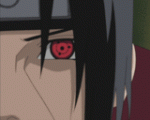
Unlike while they were still alive, the reincarnated seem to have nearly unlimited stamina and can fight continuously, as neither Kimimaro nor Itachi showed any fatigue from their illnesses as they did in life, and Itachi was even able to use multiple Mangekyō Sharingan techniques without showing exhaustion, while minor uses caused fatigue in life.
The revived are impossible to kill by normal means. Any damage they receive will easily regenerate, be it lost limbs or complete disintegration. Not even killing the summoner will get rid of them. The summoned can make practical use of the this regeneration ability by using suicide attacks and large scale ninjutsu to wipe out everything on a battlefield and then simply regenerate.
Kabuto can also modify his summoned fighters, as he did with Madara Uchiha, claiming that he made him even better than he was in his prime. Tobi also modified the eyes of the revived jinchūriki to match his own, as well as resealing the tailed beasts back into their respective hosts.
Countering
While the resurrected being immune to traditional attacks and even the death of the summoner being ineffective, there are three discovered methods to end the technique:
Seal away the soul of the revived individual.
Have the summoner end the technique. As they are unlikely to do this voluntarily, using a genjutsu to trick them into cancelling the technique is ideal. The sequence of hand seals for cancelling the technique is Dog → Horse → Tiger and saying "release" (解, kai). If the summoner dies before the technique is deactivated, then this method is impossible.
The revived individual is affected in some emotional way that gives them closure; Kankurō notes that human emotions are not so easily restrained. However, this method cannot work if the summoner destroys the personality of the revived individual before their soul is freed of its bonds.
Once any of the first three methods are accomplished, the revived will briefly regain their personalities before crumbling back into dust, leaving the bodies of the sacrificed individuals lying among the ashes.
Aside from the three methods of actually defeating the technique outright, there are three discovered methods of countering the effectiveness of this technique:
The technique can be partially combated by immobilising the bodies in a way that it cannot move, act, or be recalled by the summoner. Although this does not truly defeat the summoning, it is effective at neutralising the immediate threat the revived pose in battle.
If the revived still retain their personalities, they can speak against the user or themselves by providing hints and advice to the opponents, even in the midst of involuntarily fighting them. With considerable strength of will, the summoner's authority can even be completely overridden, albeit briefly.
A certain powerful genjutsu can free the revived person from the technique's control by giving them an order overwriting the user's control.
It should be noted that the revived are still vulnerable to any technique that could affect them while they were alive, but they are able to reform as soon as they receive any damage. Furthermore, while the reincarnated can't be destroyed and feel no pain which originates from bodily harm or mutilation, they are still vulnerable to the drawbacks from their own techniques or weaknesses. Such examples include Hanzō's poison, Mū along with the Second Mizukage being left weakened after using certain techniques, and Itachi's eye bleeding on the activation of his Mangekyō Sharingan.
Conditions
You must be registered for see images
To perform this technique, the user must first acquire some of the DNA of the person they intend to revive. Kabuto remarks that this basically amounts to grave-robbing, although blood stains or organs salvaged after the target's death also work. The soul of the intended revived must also reside in the pure world (浄土, jōdo); those whose soul has been consumed by the Death God, for example, cannot be resurrected. Next, a living sacrifice is required for the soul of the resurrected to use as a vessel. Once all prerequisites for the technique have been met, the acquired DNA of the person is smeared on a special scroll and once the scroll is activated, the remains spread out in the form of a special seal with the living sacrifice in the centre. Then dust and ash encase the sacrifice's body, giving them the same appearance that the revived had at the time of their death. The process is apparently somewhat painful as seen when Fū was used to revive Torune. The person is then revived and the end product is usually stored in a casket until summoned by the user. The user can theoretically revive a limitless number of people in this way, so long as they have enough sacrifices, chakra and DNA to perform the technique.
Details
Summoning
You must be registered for see images
You must be registered for see images
When first summoned, the body of the reincarnated is stored in a coffin; their body will appear grey and in a state of minor decay, marred by cracks and other imperfections, and the individual will also appear to be asleep. Upon awakening they retain their personality, memories, and all abilities they had in life, including kekkei genkai, kekkei tōta and summoning contracts. Although clothing is also retained by the resurrected shinobi, weaponry on the other hand is not and must be procured by the user when necessary, as seen when two members of the Seven Ninja Swordsmen of the Mist were unable to retrieve their weapons from a scroll upon ressurection, as they were currently in the possession of others. However, once obtained, shinobi that have stored their weapons in or about their person are still able to re-summon their tools, regardless of the number of times they are stored within their respective coffin. As a downside, the revived seem to retain any permanent body damage and physical limitations they received during their lifetime. The summoned all have grey sclera and retain their original eye colours however the entire eye is darkened. When Kabuto takes complete control of them however, they gain black sclera and white irides. Except for their sclera, the eye colours of dōjutsu wielders don't change at all. The summoned can be recalled at will by the user, causing an empty coffin to emerge and reclaim the individual, and the summoner can also use revived individuals to remotely summon coffins containing additional reinforcements.
Along with this, the summoned individual can feel the person's chakra flowing through them. Persons with sensory ability are also able to go one step further and decipher the actual source of the chakra that is manipulating them, even if the summoner is within the confines of a barrier. This poses a potential disadvantage to the summoner, as a renegade summon that is no longer under their direct control may be able to locate them.
Control
After the individual has been summoned and awakened, the summoner can bind the individual to their will by using a special talisman, which is attached to the end of a kunai and implanted in the brain. Upon implanting the talisman, the reincarnated individual will regenerate further, eliminating any remaining imperfections with the exception of small cracks that may run across the body and restoring colour to their bodies.
Different talismans can be used to enact different degrees of control. Orochimaru's talismans completely eliminated the personalities of the summoned, turning them into mindless killing machines under his command. Kabuto prefers to use a weaker binding talisman on certain individuals, allowing them to retain some degree of their own personality. The latter method is useful for psychological warfare, and can also allow the summoned individual to tap into their own emotions, memories, or creativity to enhance their effectiveness in combat, but also carries a host of drawbacks; it takes more effort to retain control with the weaker binding which can make it possible for the hearts of the summoned to be swayed by strong emotions, which can result in the soul breaking free and returning to the Pure World, or the reincarnated contradicting orders that they are given. Reincarnated shinobi with their personalities still intact have their movements limited to certain actions, and are basically on "auto-pilot" to react to enemy techniques. Once they recognise an enemy technique their bodies are programmed to counter it with an appropriate method.
Even so, Kabuto can completely remove their personalities if needed, and may elect to if they resist his command too strongly. After gaining more experience with the technique, and absorbing Orochimaru's chakra from Anko Mitarashi, Kabuto exerts greater control over the summoned and can even overwrite his own talismans, greatly increasing the power of the binding. Once deployed, he can either remotely control or track the summoned individuals using pebbles he manipulates on a simple grid, which acts as a map of sorts. The pebble for his trump card was black in colour while the others are light-coloured. The summoner can also directly talk through the summoned individual
Enhancements
Unlike while they were still alive, the reincarnated seem to have nearly unlimited stamina and can fight continuously, as neither Kimimaro nor Itachi showed any fatigue from their illnesses as they did in life, and Itachi was even able to use multiple Mangekyō Sharingan techniques without showing exhaustion, while minor uses caused fatigue in life.
The revived are impossible to kill by normal means. Any damage they receive will easily regenerate, be it lost limbs or complete disintegration. Not even killing the summoner will get rid of them. The summoned can make practical use of the this regeneration ability by using suicide attacks and large scale ninjutsu to wipe out everything on a battlefield and then simply regenerate.
Kabuto can also modify his summoned fighters, as he did with Madara Uchiha, claiming that he made him even better than he was in his prime. Tobi also modified the eyes of the revived jinchūriki to match his own, as well as resealing the tailed beasts back into their respective hosts.
Countering
While the resurrected being immune to traditional attacks and even the death of the summoner being ineffective, there are three discovered methods to end the technique:
Seal away the soul of the revived individual.
Have the summoner end the technique. As they are unlikely to do this voluntarily, using a genjutsu to trick them into cancelling the technique is ideal. The sequence of hand seals for cancelling the technique is Dog → Horse → Tiger and saying "release" (解, kai). If the summoner dies before the technique is deactivated, then this method is impossible.
The revived individual is affected in some emotional way that gives them closure; Kankurō notes that human emotions are not so easily restrained. However, this method cannot work if the summoner destroys the personality of the revived individual before their soul is freed of its bonds.
Once any of the first three methods are accomplished, the revived will briefly regain their personalities before crumbling back into dust, leaving the bodies of the sacrificed individuals lying among the ashes.
Aside from the three methods of actually defeating the technique outright, there are three discovered methods of countering the effectiveness of this technique:
The technique can be partially combated by immobilising the bodies in a way that it cannot move, act, or be recalled by the summoner. Although this does not truly defeat the summoning, it is effective at neutralising the immediate threat the revived pose in battle.
If the revived still retain their personalities, they can speak against the user or themselves by providing hints and advice to the opponents, even in the midst of involuntarily fighting them. With considerable strength of will, the summoner's authority can even be completely overridden, albeit briefly.
A certain powerful genjutsu can free the revived person from the technique's control by giving them an order overwriting the user's control.
It should be noted that the revived are still vulnerable to any technique that could affect them while they were alive, but they are able to reform as soon as they receive any damage. Furthermore, while the reincarnated can't be destroyed and feel no pain which originates from bodily harm or mutilation, they are still vulnerable to the drawbacks from their own techniques or weaknesses. Such examples include Hanzō's poison, Mū along with the Second Mizukage being left weakened after using certain techniques, and Itachi's eye bleeding on the activation of his Mangekyō Sharingan.