Too bad sage art is found nowhere in that chapter.
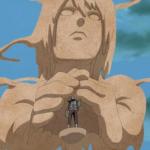
The senju name derives from clan with a thousand skills and the summoning or justu whatever it is was called shinsuusenju
Where do you possibly get sage art from ?
Anyway the summoning is another reference to buddhism which was the whole theme of the rinnegan.
Its also a reference to the will of the sage and the fragile relationship between madara and hashirama
Read up on Guanyin and the Thousand Arms
sage mode lol :sy:
One Buddhist legend from the Complete Tale of Guanyin and the Southern Seas (Chinese: 南海觀音全撰; pinyin: Nánhǎi Guānyīn Quánzhuàn) presents Guanyin as vowing to never rest until she had freed all sentient beings from the samsara or reincarnation. Despite strenuous effort, she realised that there were still many unhappy beings yet to be saved. After struggling to comprehend the needs of so many, her head split into eleven pieces. The buddha Amitabha, upon seeing her plight, gave her eleven heads to help her hear the cries of those who are suffering. Upon hearing these cries and comprehending them, Avalokitesvara attempted to reach out to all those who needed aid, but found that her two arms shattered into pieces. Once more, Amitabha came to her aid and appointed her a thousand arms to let her reach out to those in need. Many Himalayan versions of the tale include eight arms with which Avalokitesvara skillfully upholds the Dharma, each possessing its own particular implement, while more Chinese-specific versions give varying accounts of this number.
In China, it is said that fishermen used to pray to her to ensure safe voyages. The titles Guanyin of the Southern Ocean (南海觀音) and "Guanyin (of/on) the Island" stem from this tradition.
You must be registered for see images
Guanyin, sitting in the lotus position. The damaged hands probably performing dharmacakramudra, a gesture that signifies the moment when Buddha put the wheel of learning in motion. Painted and gilded wood. China. Song/Jin period, late 13th century.
You must be registered for see images
This wooden statue of Quan Âm Nghìn Mắt Nghìn Tay (Quan Am with 1000 eyes and 1000 hands) was fashioned in 1656 in Bắc Ninh Province, northern Vietnam. It is now located in the History Museum in Hanoi.
Anyone else notice the striking resemblance to the gedo mazou ?
Especially the part about where the hands are broken off which coincides and contrast with what the gedo mazou is being used to do,which is essentially still helping people but forcefully through power (infinite tsukuyomi)